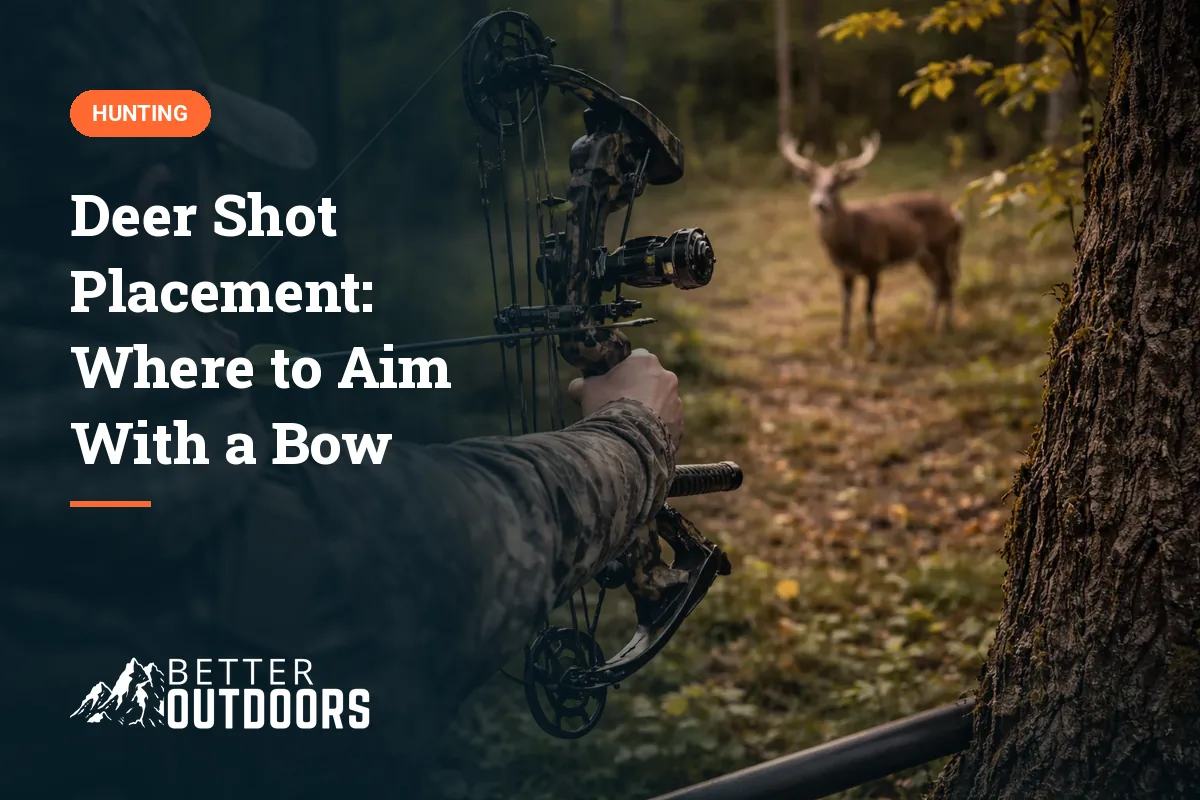
Deer Shot Placement: Where to Aim With a Bow
Double-lung aiming points for every angle, the shots to pass on, and how to read your hit before you start tracking.
Better Outdoors is reader-supported. When you buy through our Amazon links we may earn a commission, at no extra cost to you. Learn more.
Key Takeaways
- Good deer shot placement with a bow means sending the arrow through both lungs. On a broadside deer, aim tight behind the front leg, about one-third of the way up the body.
- Take only broadside or quartering-away shots with archery gear. Pass on facing, quartering-toward and straight-away deer.
- Pick a tiny spot on the hair, not the whole deer, and think about where the arrow will exit.
- Read the arrow and blood after the shot, then wait before tracking. Waiting longer is almost always the safer choice.
- Practice on a 3D deer target from the angles and heights you will actually hunt.
Deer shot placement is the single biggest factor in whether a bowhunt ends with a short, easy recovery or a long night of tracking. With a bow, the best shot placement on a deer is a double-lung hit: on a broadside whitetail, aim just behind the front leg and about one-third of the way up from the bottom of the chest. That spot puts both lungs, and often the top of the heart, right in the arrow’s path.
This Better Outdoors guide covers deer anatomy, where to aim at each angle, aiming from elevation, which shots to pass on, reading your hit, and practice. Hunting rules differ by state, so always check your local regulations, licensing and legal equipment before you go.
Try the free Kinetic Energy & Momentum CalculatorSee if your setup has the energy for your game.Why Shot Placement Matters More With a Bow
A rifle bullet carries a lot of energy and can do damage well beyond its path. A broadhead does its work almost entirely along the line it travels. It slices through tissue and blood vessels, and the deer goes down from blood loss. That has two consequences for bowhunters:
- The margin for error is smaller. An arrow that misses the vitals by a few inches may leave a wounded deer that is very hard to recover.
- Bone matters. The heavy shoulder blade and leg bones can stop or deflect an arrow, especially from lighter setups. Shot angle decides whether bone is in the way.
That is why rifle-style neck, head and high-shoulder shots are poor choices with archery equipment. Bowhunters focus on the chest cavity, where the largest vital organs sit.
Whitetail Deer Anatomy: What You Are Aiming At
Many new hunters picture the heart in the middle of the chest. It actually sits low, between the front legs. Here is what lies inside, front to back:
| Organ | Where it sits | What a hit usually means |
|---|---|---|
| Lungs | The largest target; fills most of the chest cavity behind the shoulder | The best target for bowhunters. A double-lung hit is usually quick and leaves a good blood trail |
| Heart | Low in the chest, between and slightly behind the front legs | Lethal, but a small target close to the leg bones; aim slightly higher and catch the lungs too |
| Major blood vessels | Above the heart, at the top of the lungs | Lethal when cut; part of why a centered lung shot works so well |
| Liver | Just behind the diaphragm, behind the lungs | Lethal but slower; needs a longer wait before tracking |
| Stomach and intestines | Behind the liver, filling the rear of the body | Slow and difficult to recover; requires a long wait |
| Spine | Along the top of the back, lower than many hunters expect | Drops a deer if hit, but a near miss above it often leaves a superficial wound |
The vital area of an adult whitetail is often compared to a paper plate, give or take, depending on the size of the deer. The lungs fill most of that area, which is exactly why they are the target. If your arrow lands anywhere inside that zone, you have a lethal hit.
Deer Shot Placement Chart by Angle
A deer shot placement chart is really a chart of angles. The aiming point moves as the deer turns, because you want the arrow to pass through the same organs no matter how the deer stands. Use this as a quick reference:
| Deer position | Take the shot? | Where to aim |
|---|---|---|
| Broadside | Yes, the ideal shot | Tight behind the front leg, one-third of the way up the body |
| Slight quartering away | Yes, often the best shot | Behind the last rib, angled so the arrow exits near the off-side front leg |
| Hard quartering away | Only with care and good arrow energy | Farther back, aiming at the off-side shoulder; liver hits are more likely |
| Quartering toward | No | Shoulder and leg bones protect the vitals; wait for the deer to turn |
| Facing you | No | Too much bone and a tiny opening |
| Facing straight away | No | No clear path to the lungs |
The Broadside Shot
For a broadside deer, follow the back edge of the front leg up the body. Stop about one-third of the way up from the bottom of the chest, and pick a spot there. That puts your arrow through both lungs, with room for error above and below. Going a touch lower can catch the heart; going a few inches too far back still tends to catch the liver.
The best broadside shot comes when the near-side front leg is stepped forward. That moves the shoulder blade and leg bone forward and opens up the lungs. If the leg is back, the shoulder covers more of the vitals, so wait a moment if you can.
The Quartering-Away Shot
Many experienced bowhunters prefer a slight quartering-away deer over a perfect broadside. The arrow can slip in behind the ribs and angle forward through both lungs without touching heavy bone. The trick is to forget where the arrow goes in and focus on where it comes out. Aim so the arrow would exit at the off-side front leg. On a sharp angle, your entry point may be well behind the near-side shoulder, sometimes behind the last rib.
Shots to Pass Up
Quartering-toward, head-on and straight-away shots are poor choices with a bow. The shoulder, leg and spine block the vitals, and the opening that is left is small. Letting a deer walk past without a shot is part of ethical bowhunting. In many cases, a deer that is quartering toward you will turn broadside within a few steps.
Shot Placement From a Treestand
Elevation changes everything about deer shot placement. From a stand, the arrow enters high and exits low. The lungs present a narrower target from above, and the spine is more in play if you aim high. The rule is the same as for quartering shots: aim for the exit. Visualize the arrow’s path and pick an entry point that sends it through both lungs and out low on the far side. That usually means aiming a little lower on the near side than you would from the ground.
Close, steep shots right under the stand are the hardest, so most hunters let those deer walk out a few more yards. Bend at the waist rather than dropping your bow arm, so your anchor stays the same. Our guide to treestand bowhunting tips covers shooting form, angles and harness safety in detail. Always wear a full-body safety harness and stay connected to the tree from the time you leave the ground.
Distance, Alert Deer and “String Jumping”
Deer react fast. When a deer hears the shot, it often drops its body to load its legs before it bolts. Bowhunters call this “jumping the string.” The drop can move the vitals several inches before the arrow arrives, and the effect grows with distance and with how alert the deer is.
- Stay inside your effective range: the distance at which every arrow lands in the vital zone under hunting conditions.
- Shoot relaxed deer. A feeding deer reacts less sharply than one staring at you.
- Stop a walking deer first. A soft mouth grunt often stops a deer for a second. Be drawn and ready before you make the sound.
- Know the distance. Range landmarks before deer arrive. An angle-compensating rangefinder, such as the AOFAR HX-1200T hunting rangefinder, shows horizontal distance, which is what matters for pin choice from a stand.
Arrow setup matters too. A well-tuned arrow with enough weight and a sharp broadhead holds up better if it does clip bone. Check your arrow’s energy and momentum with our kinetic energy calculator, and see our guide on how heavy your arrow should be.
Reading Your Hit After the Shot
What you do in the first minutes after the shot often decides whether you recover the deer. Before you climb down or walk forward, take a breath and replay what you saw.
- Watch the deer. Note how it ran and where you last saw it. A hunched, slow walk can suggest a gut hit.
- Mark your spot where the deer stood and where it disappeared, with a GPS app or flagging tape.
- Stay quiet. Listen for a crash. Do not chase a deer that might be wounded.
- Find the arrow and read it. When it is safe to move, check the arrow and the ground at the hit site.
A lighted nock makes the first two steps far easier, especially in low light. You can follow the arrow’s flight and often see where it hit. Popular options include the Nockturnal GT lighted nocks; check local regulations first, because a few states have rules on lighted nocks.
| Sign on the arrow or trail | Likely hit | Common guidance before tracking |
|---|---|---|
| Bright red or pink blood with tiny bubbles | Lungs | Wait at least 30 minutes to an hour, then track quietly |
| Bright red blood, heavy trail, deer ran hard | Heart or major vessels | Usually a short trail; still give it time |
| Dark red blood, little or no froth | Liver | Wait several hours before following |
| Brown or green material, foul smell | Stomach or intestines | Wait many hours, often overnight in cool weather |
| Little blood, hair only, or arrow stopped by bone | Muscle or bone, possibly a shoulder hit | Back out, look carefully, and consider getting help |
These wait times are common rules of thumb, not guarantees. Weather and temperature affect the decision, and when in doubt, wait longer. Some states allow leashed tracking dogs; check your local regulations.
Tracking Gear That Helps
Blood can be hard to see after dark, on leaves or in grass. A dedicated tracking light such as the PRIMOS Bloodhunter HD is designed to make blood stand out against the forest floor. Bring flagging tape to mark the trail, a headlamp with spare batteries, and a phone. Our bowhunting gear checklist helps make sure nothing gets left in the truck.
How to Practice Deer Shot Placement
Bullseye targets build form, but they do not teach you to find the vitals on a real animal. Practice on deer-shaped targets from the angles you will see in the field.
- Shoot a 3D deer target from different angles and heights, aiming without looking at the scoring rings.
- Use photo-realistic deer faces to practice picking a spot on hair, not rings.
- Practice from elevation if you hunt from a stand, with your harness on and attached.
- Shoot one cold arrow at the end of each session. The first shot of the day is the one that counts.
- Confirm your broadheads fly with your field points, using a broadhead-rated target.
Sight setup matters as much as aim. If your pins are not dialed in, a perfect aiming point still produces a bad hit. See our guide on how to sight in a compound bow, and make sure your bow fits you: our draw length calculator and guide on how to adjust draw length help you get there. If you are still choosing a bow, our article on ready-to-hunt bow packages explains what a good starter setup includes.
Gear for better shot placement and recovery
SHOOTER Buck 3D Archery Target
A full-size buck target with a replaceable vital insert for angle practice.
- Lifelike deer shape
- Replaceable insert
Broadside & Quartering Deer Target Faces
Photo-realistic broadside and quartering-away deer faces.
- Several shot angles
- Inexpensive practice
NAP Thunderhead Fixed-Blade Broadheads
A long-running fixed-blade design. Confirm flight against your field points.
- Fixed-blade design
- Pack of five
AOFAR HX-1200T Rangefinder
Shows angle and horizontal distance for shots from a stand or slope.
- Angle and horizontal distance
- Compact size
Nockturnal GT Lighted Nocks
Lights on the shot so you can follow the arrow. Check local rules first.
- Bowstring-activated
- Three-pack
PRIMOS Bloodhunter HD Tracking Light
Built to make blood easier to spot after dark.
- Made for blood trailing
- Handheld
As an Amazon Associate, Better Outdoors earns from qualifying purchases.
Common Shot Placement Mistakes
- Aiming too high. The lungs sit lower than the middle of the deer, and a high hit can pass above them.
- Aiming too far forward. Stay tight behind the leg, not on the shoulder bone.
- Ignoring the angle. A broadside aiming point on a quartering deer pushes the arrow into the paunch or shoulder.
- Shooting through brush. Even small twigs can deflect an arrow. Use clear lanes only.
- Tracking too soon. Pushing a deer can lose even a good hit.
Putting It All Together
Good deer shot placement is simple to describe and takes practice to do well. Wait for a calm broadside or quartering-away deer inside your effective range, pick a small spot that sends the arrow through both lungs, then read your hit and give the deer time. Follow your state’s regulations and licensing rules, and take a bowhunter education course if your state requires or offers one.
Frequently Asked Questions
Where is the best place to shoot a deer with a bow?
For most bowhunters, the best place is the double-lung area. On a broadside deer, aim tight behind the front leg about one-third of the way up the body. That sends the arrow through both lungs and often the top of the heart.
Should I aim for the heart or the lungs?
Aim for the lungs. The heart sits low between the front legs and is a small target close to heavy bone. A center-lung aiming point gives you more room for error, and a slightly low hit can still catch the heart.
Is a quartering-away shot better than broadside?
A slight quartering-away angle is often considered one of the best bow shots, because the arrow can pass behind the ribs and forward through both lungs. Aim so the arrow would exit near the off-side front leg. Broadside is also an excellent shot.
Why should I not take a quartering-toward shot with a bow?
On a quartering-toward deer, the shoulder blade and leg bones cover much of the vital area. An arrow may stop on bone or miss the lungs entirely. Most bowhunters wait for the deer to turn broadside or quartering away.
How long should I wait before tracking a deer?
It depends on the hit. Common guidance is at least 30 minutes to an hour for a lung hit, several hours for a liver hit, and many hours or overnight for a gut hit. When in doubt, wait longer and back out quietly.
What is the best way to practice deer shot placement?
Shoot a 3D deer target or photo-realistic deer faces from many angles and heights, aim at a small spot rather than the rings, and finish each session with one cold arrow. Confirm your broadheads fly with your field points before the season.

We are bowhunters and gear nerds who test, tune and shoot the equipment we write about. Every Better Outdoors guide is checked against manufacturer specs and updated as models change. How we review gear.
Related Articles
 Bow Reviews
Bear Archery Species XT RTH Compound Bow Review
Bear's value-focused ready-to-hunt bow: specs, package contents and how it stacks up against the Alaskan XT.
 Bow Guides
Ready-to-Hunt Compound Bow Packages: What Features to Look For
Adjustability, sight, rest and quiver quality: the checklist for picking an RTH package you will not outgrow in a season.
 Bow Tuning
How to Adjust Draw Length on a Compound Bow
Measure, identify your cam, move the modules and re-tune: a brand-neutral guide to adjusting draw length the right way.