How Heavy Should Your Arrow Be for Bowhunting?
Grains per pound, spine and front-of-center explained, with arrow weight targets for each kind of game.

Better Outdoors is reader-supported. When you buy through our Amazon links we may earn a commission, at no extra cost to you. Learn more.
Key Takeaways
- The IBO minimum is 5 grains per pound of draw weight. Going lighter can damage your bow and void the warranty.
- Most bowhunters land somewhere around 6 to 8+ grains per pound, heavier for bigger game.
- Total weight is only half the job. The arrow also needs the right spine for your draw weight, length and point weight.
- FOC (front-of-center) tells you how far forward the balance point sits. More FOC helps broadhead flight and penetration.
- A lighter arrow is faster and flatter. A heavier arrow carries more momentum and is quieter. Pick the trade-off that fits your hunt.
How heavy should my arrow be? It is one of the most common questions at any archery counter, and the honest answer is “it depends on your bow and your game.” Still, there are clear rules. A minimum keeps your bow safe, a usual range covers most hunting, and two numbers, kinetic energy and momentum, show what you gain or give up when you add weight.
This Better Outdoors guide covers grains per pound, arrow spine, FOC and the heavy-versus-light debate, so you can pick an arrow weight for deer or elk with confidence.
How Heavy Should My Arrow Be? The Short Answer
Total arrow weight is measured in grains (7,000 grains = 1 pound). It covers everything: shaft, insert, nock, fletching, wrap and point or broadhead. Most hunting arrows weigh somewhere between about 350 and 550 grains, but the number that matters is weight compared with your draw weight. That ratio is called grains per pound (GPP).
- Never below 5 GPP. That is the IBO minimum, and most bow makers warn against going under it.
- About 6–7 GPP is a common, balanced choice for whitetail-size game.
- About 7–8+ GPP is common for elk, moose, bear and other large or tough animals.
Treat these as general guidance, not a law. Your bow manual, your arrow maker’s spine chart and your own tuning results come first.
Grains Per Pound: The 5 GPP Minimum and Beyond
To find GPP, divide total arrow weight by peak draw weight. A 420-grain arrow from a 60-pound bow is 7 GPP. A 350-grain arrow from a 70-pound bow is exactly 5 GPP, right on the line.
Why a minimum? When you shoot, most of the energy stored in the limbs goes into the arrow. A very light arrow can’t absorb it all, so the leftover energy goes back into the limbs, cams and string, like a milder dry fire. Over time it can crack limbs or damage cams.
Use this table to see what each ratio means in real arrow weights. Find your draw weight on the left and read across.
| Draw weight | 5 GPP (minimum) | 6 GPP | 7 GPP | 8 GPP |
|---|---|---|---|---|
| 50 lb | 250 gr | 300 gr | 350 gr | 400 gr |
| 55 lb | 275 gr | 330 gr | 385 gr | 440 gr |
| 60 lb | 300 gr | 360 gr | 420 gr | 480 gr |
| 65 lb | 325 gr | 390 gr | 455 gr | 520 gr |
| 70 lb | 350 gr | 420 gr | 490 gr | 560 gr |
| 80 lb | 400 gr | 480 gr | 560 gr | 640 gr |
Arrow Weight for Deer, Elk and Bigger Game
Your game sets how much margin you want. Bigger animals have thicker hide, heavier bone and more muscle, so many hunters add weight for them.
| Game | Common GPP range | Example at 60 lb | Example at 70 lb |
|---|---|---|---|
| Turkey, small game | 5–6 | 300–360 gr | 350–420 gr |
| Whitetail, pronghorn | 6–7 | 360–420 gr | 420–490 gr |
| Mule deer, black bear | 6.5–7.5 | 390–450 gr | 455–525 gr |
| Elk, moose, large bear | 7–8+ | 420–480+ gr | 490–560+ gr |
Arrow weight for deer: a well-tuned arrow of about 6 to 7 GPP with a sharp broadhead is plenty for whitetail at normal bow ranges. Shot placement matters far more than an extra 30 grains.
Arrow weight for elk: many elk hunters go to 7 GPP or more, often with a heavier broadhead or a weighted insert to raise FOC. Longer shots and big shoulder bones are the reason. If you hunt with a lighter draw weight, extra arrow weight helps you keep momentum up.
Shooting a lighter bow, like a youth bow or a setup around 50 pounds? Look at our Bear Alaskan XT RTH review for an example of an adjustable hunting bow, and size your arrow to the draw weight you actually shoot, not the bow’s max.
Arrow Spine Chart Basics: Weight Isn’t Everything
Spine is how much an arrow shaft bends. It is listed as a number like 300, 340 or 400. That number is the deflection in thousandths of an inch under a standard test, so a lower number means a stiffer shaft. A 300-spine arrow is stiffer than a 400.
When you shoot, the arrow flexes as it leaves the bow. If the spine is wrong, the arrow fishtails or porpoises, and broadheads exaggerate the problem. Three things decide what spine you need:
- Draw weight: more pounds need a stiffer (lower number) shaft.
- Arrow length: a longer arrow acts weaker, so it may need a stiffer shaft.
- Point weight: a heavier point or broadhead makes the arrow act weaker.
Every arrow maker publishes its own spine chart, and charts differ between brands and models. Look up your draw weight, cut arrow length and point weight on the chart for the exact shaft you plan to buy. If you land between two sizes, many shooters pick the stiffer one when they plan to use heavy heads.
What Is FOC and How Much Do You Need?
FOC means front-of-center. It describes how far the balance point sits ahead of the arrow’s middle, as a percentage of its length. A higher FOC means more weight up front.
Here is a simple way to measure it:
- Measure arrow length (L) from the bottom of the nock groove to the end of the shaft.
- Find the balance point with the point or broadhead on. Balance it on a knife edge and measure from the nock groove to that spot (B).
- Calculate: FOC % = (B − L/2) ÷ L × 100.
Example: a 28-inch arrow that balances 17.5 inches from the nock groove has (17.5 − 14) ÷ 28 × 100 = 12.5% FOC.
Many target and hunting arrows fall around 10 to 15% FOC, and some big-game hunters build arrows well above that. More FOC tends to help broadheads steer and fly straight, and can help penetration. The trade-off is that adding point weight weakens dynamic spine and adds total weight, which slows the arrow down.
Common ways to raise FOC include a heavier broadhead, a brass or steel insert, a weight collar, or lighter fletching and nocks at the back.
Heavy vs. Light Arrows: Kinetic Energy and Momentum
This is the core of the debate. A lighter arrow leaves the bow faster. A heavier arrow leaves slower but hits harder in a different way. Two formulas show the difference, and they are the same ones our calculators use:
| Kinetic energy (ft-lb) | arrow weight (gr) × speed (fps)² ÷ 450,240 |
|---|---|
| Momentum (slug-ft/s) | arrow weight (gr) × speed (fps) ÷ 225,218 |
Kinetic energy squares the speed, so it rewards fast arrows. Momentum grows evenly with weight, so it rewards heavy arrows. Momentum is often seen as a better hint of how well an arrow keeps pushing through hide and bone after impact.
Here is how three arrows might compare out of the same bow. The speeds are made-up examples for illustration, not test results; your bow will differ.
| Arrow | Example speed | Kinetic energy | Momentum |
|---|---|---|---|
| 350 gr (light) | 300 fps | 70.0 ft-lb | 0.466 |
| 425 gr (middle) | 280 fps | 74.0 ft-lb | 0.528 |
| 500 gr (heavy) | 260 fps | 75.1 ft-lb | 0.577 |
Notice the pattern. Kinetic energy barely changes, but momentum climbs about 24% from the lightest to the heaviest arrow. A heavier arrow also tends to absorb more of the bow’s energy, so the shot is usually quieter with less hand shock.
So why shoot light arrows at all? Speed flattens trajectory. If you misjudge range by 5 yards, a fast arrow drops less. It also reaches the animal sooner, giving it less time to react.
Try the free Kinetic Energy & Momentum CalculatorSee if your setup has the energy for your game.The Practical Middle Ground
At Better Outdoors we recommend most whitetail hunters start around the middle of the range, roughly 6.5 GPP, and then build FOC with the point and insert. You keep a fairly flat trajectory, plenty of momentum for deer, and good broadhead flight. Go heavier if you hunt elk or bear, take steep angles, or shoot lower draw weights.
How to Choose Your Arrow Weight, Step by Step
- Weigh your bow. Use a bow scale to find your real peak draw weight. Many bows read a few pounds off the label.
- Pick a GPP target for your game: about 6–7 for deer, 7–8+ for elk and big game. Never under 5.
- Find your spine on the arrow maker’s chart using draw weight, cut length and point weight.
- Add up the weight. Shaft grains per inch × length, plus insert, point, nock, vanes and wrap. A digital grain scale makes this easy.
- Check FOC and adjust with point or insert weight if needed. Re-check spine after any change.
- Shoot and tune. Paper tune or bare-shaft tune, then confirm broadheads hit with field points.
Want to see how a new arrow weight changes your speed? Enter your bow’s IBO rating, draw length, draw weight and arrow weight in our speed tool.
Try the free Arrow Speed CalculatorTurn an IBO rating into your real-world FPS.Tools for building the right arrow
Digital Grain Scale
Weighs arrows, points and components to the grain so you know your true total arrow weight.
- Checks GPP accurately
- Helps match arrows
Bow Draw Weight Scale
Measures your real peak draw weight, the starting point for every GPP calculation.
- Catches label errors
- Useful after limb bolt changes
Arrow Weight Inserts
Brass or steel inserts and weight collars add grains up front to raise FOC.
- Raises FOC
- Fine-tunes total weight
As an Amazon Associate, Better Outdoors earns from qualifying purchases.
Common Arrow Weight Mistakes
- Going under 5 GPP to chase a speed number. It risks bow damage and rarely helps in the field.
- Ignoring spine when changing points. A heavier head on the same shaft can wreck broadhead flight.
- Guessing total weight. Vanes, wraps and lighted nocks add up. Weigh a finished arrow.
- Mixing arrows. Arrows in your quiver should match in weight within a few grains for consistent groups.
- Skipping re-sighting. Any change in arrow weight changes speed and drop, so your pins move. Our guide on how to sight in a compound bow covers the full process.
Shopping for complete arrows? Browse carbon hunting arrows and 125-grain broadheads once you know your spine and target weight.
Final Thoughts
So, how heavy should your arrow be? Stay above 5 grains per pound, aim for roughly 6 to 7 GPP for deer and 7 to 8+ for elk and bigger game, match the spine to your setup, and build sensible FOC. Then shoot it. A tuned arrow you trust, with a sharp broadhead and good shot placement, beats any number on a chart.
Frequently Asked Questions
How heavy should my arrow be for my draw weight?
Multiply your draw weight by a grains-per-pound target. Never go below 5 GPP (the IBO minimum). About 6–7 GPP is common for deer and 7–8+ GPP for elk and bigger game. For a 60-pound bow, that is roughly 360–420 grains for deer.
What is the minimum arrow weight for a compound bow?
The IBO standard is 5 grains per pound of draw weight, so a 70-pound bow needs at least a 350-grain arrow. Some manufacturers set their own minimum, so check your owner’s manual.
What arrow weight is best for deer?
Most whitetail hunters do well with about 6 to 7 grains per pound and a sharp broadhead. Good shot placement and a well-tuned arrow matter more than small weight changes.
What arrow weight should I use for elk?
Many elk hunters shoot 7 grains per pound or more, often with higher FOC. The extra momentum helps with thick hide, heavy bone and longer shots.
How do I read an arrow spine chart?
Find your draw weight and your cut arrow length on the chart for the exact shaft you plan to buy, then adjust for point weight. Lower spine numbers are stiffer. Charts differ between brands, so use the maker’s own chart.
What is a good FOC for a hunting arrow?
Many hunting arrows fall around 10 to 15% FOC, and some big-game hunters go higher. More FOC can help broadhead flight and penetration but adds weight and weakens dynamic spine.
Are heavy arrows better than light arrows?
Neither is better for every hunt. Heavy arrows carry more momentum and are quieter. Light arrows are faster and flatter, which helps if you misjudge range. Many hunters choose a middle weight.
Does arrow weight affect kinetic energy or momentum more?
Momentum. Kinetic energy (grains × fps² ÷ 450,240) changes little as you add weight because speed drops. Momentum (grains × fps ÷ 225,218) rises steadily with heavier arrows.
Do I need to re-sight my bow after changing arrow weight?
Yes. A different arrow weight changes speed and trajectory, so your pins will move. Re-sight at 20 yards first, then check every pin.

We research gear specs, manufacturer data and owner feedback so you can choose with confidence. Every Better Outdoors guide is checked against manufacturer specs and updated as models change. How we review gear.
Related Articles
 Bow Tuning
How to Sight In a Compound Bow, Step by Step
Follow the arrow, set pins from 20 to 60 yards, and confirm your broadheads hit with your field points.
 Bow Tuning
How to Adjust Draw Length on a Compound Bow
Measure, identify your cam, move the modules and re-tune: a brand-neutral guide to adjusting draw length the right way.
 Bow Tuning
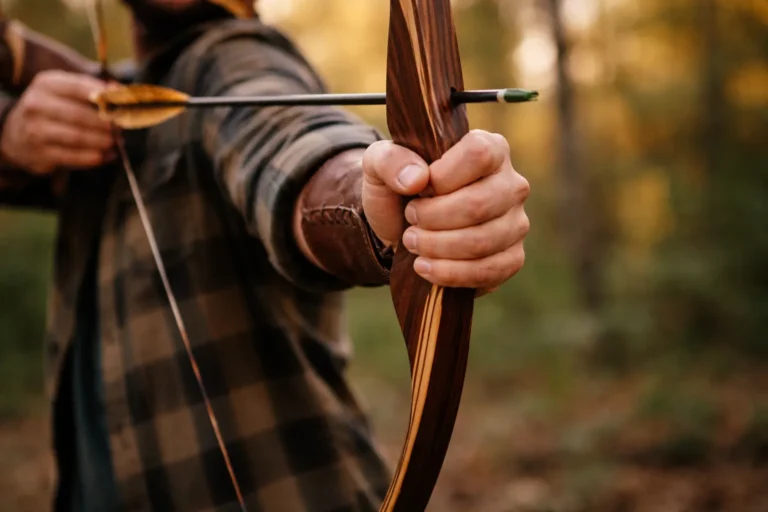
Bear Archery Bear Paw Grip: Design, Feel, and Performance
How grip shape and wrist angle drive torque and accuracy, and how to tell whether a Bear bow grip suits your hand.